Your Menu Is a Sales Tool and an Operations Tool. Most Restaurants Treat It as Neither.

Most restaurant owners think about their menu when they open, and then again when something is clearly not working. A dish nobody orders. A price that feels off. A special that became permanent because customers kept asking for it.
In between those moments, the menu just sits there. It grows a little here, loses an item there, picks up a new section that made sense at the time. Nobody looks at it as a whole thing. Nobody asks whether it is still doing its job.
That is the most expensive version of a menu there is.
A Menu Has Two Jobs
The first job is what most owners think of: it tells customers what you sell and at what price. It guides them toward a decision. Done well, it guides them toward a decision that is good for them and good for your margins.
The second job is less obvious but just as important. It tells your staff what they are selling and how to ring it in. It shapes how quickly your kitchen can execute. It determines how long it takes to train a new hire. It controls how many errors make it onto a ticket during a busy service.
When a menu does both jobs well, the operation feels easy. Orders are accurate. The kitchen runs clean. Staff can answer questions without finding you first. Customers leave happy.
When a menu does neither job well, you feel it in every service, but it is hard to point to exactly where the problem is coming from.
The Menu That Grew Without a Plan
Here is how most restaurant menus actually develop.
You open with a menu that someone put together during the planning phase, probably under time pressure. Then you add a seasonal item that did well and never take it off. Then a regular asks for something that is not on the menu and you start making it. Then a supplier runs out of an ingredient so you swap in something else and never update the description. Then a staff member adds a modifier in the POS because they needed it one night and nobody has looked at it since.
Three years later, your menu has 47 items across 9 categories, three of which have only one item in them. There are modifiers that no longer apply to anything. There are dishes described with ingredients you stopped using. There are prices that have not been adjusted even though your costs went up six months ago.
None of this happened because of carelessness. It happened because the menu never had a dedicated moment to be looked at honestly.
The result is a menu that no longer reflects how your restaurant actually operates, what your customers actually order, or what actually makes you money.
When the Menu Works Against Your Kitchen
A menu problem is not just a customer-facing problem. It shows up on the line.
When a menu has too many items, your kitchen has to prep for all of them. Ingredients overlap in ways that create waste. A slow-moving dish keeps a prep cook busy for two hours a week producing something that gets 86’d twice a month. The labor and the food cost are both real. The sales volume does not justify either of them.
When a menu is disorganized inside the POS, staff slow down during service. We covered this in our post on Clover POS mistakes: a cashier navigating four sub-menus to find a simple modification is a cashier who is not paying full attention to the order. That is how wrong items make it to the kitchen, wrong dishes make it to the table, and you end up comping a meal that cost you twice.
When modifiers are set up as a substitute for proper menu structure, tickets become unclear. The kitchen receives instructions that require interpretation rather than execution. Interpretation during a rush leads to guessing. Guessing leads to mistakes.
The menu sits upstream of all of it. Get the menu right, and many of those kitchen problems get smaller on their own.
What Your Menu Is Telling You About Your Margins
Most restaurant owners know their overall food cost percentage. Very few know the food cost on each individual item.
That matters because your menu is probably carrying items that are popular but quietly hurting your margins. A dish that sells well but costs a lot to produce can eat into your overall profitability in ways that are hard to see unless you are looking item by item.
The flip side is also true. You probably have items on your menu that are cheap to produce, priced well, and barely promoted because they ended up buried in the middle of a crowded category where nobody notices them.
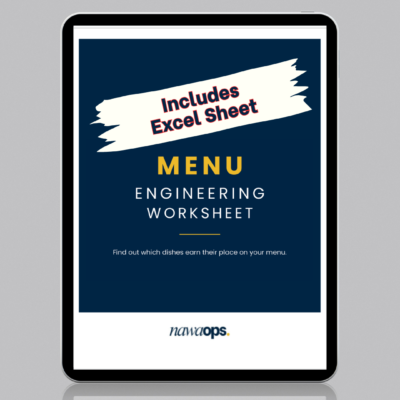
Menu engineering is the practice of understanding which items are popular and which ones are profitable, and then building your menu around that reality. It is not about removing everything that is hard to make. It is about knowing what you are working with so you can make deliberate decisions instead of hoping the right things sell.
A simple version of this analysis takes an afternoon. You pull your sales data, calculate the food cost on your top sellers, and look at what is actually driving your margins versus what is creating the illusion of a busy restaurant while the money quietly leaks out.
Most restaurants have never done this. The ones that have usually find at least one or two surprises worth acting on immediately.
The Gap Between Your Menu and Your POS
This is where things get practical.
Your printed or online menu and your POS menu should tell the same story. In most restaurants, they do not. Items exist in one but not the other. Prices are slightly different. A modifier on the POS does not match an option listed on the customer-facing menu. A new item was added to the website but nobody updated the POS, so staff figure out how to ring it in differently every single time someone orders it.
These gaps create friction at every transaction. Staff improvise. Customers get charged incorrectly or not at all. The kitchen receives inconsistent instructions. Managers spend time answering questions that a properly built system would handle without them.
Closing the gap between your customer-facing menu and your POS menu is not complicated work, but it is the kind of work that makes every shift run a little cleaner without anyone having to try harder.
What a Well-Built Menu Actually Does
When a menu is built with intention, cleaned up, and kept current, the effects show up in places you might not expect.
Training gets faster. A new hire working with a clean, logical POS menu can learn the system in a fraction of the time it takes to navigate a cluttered one. That matters when staff turnover is high and getting someone productive quickly is a real operational need.
Order accuracy goes up. When staff can find what they need without guessing, they enter orders correctly. When the kitchen receives clear tickets, they produce the right food. The chain of errors that starts at a messy POS menu and ends with a comp at the table gets much shorter.
Margins improve over time. When you know which items are profitable and build your menu to support them, what sells starts shifting in your favor. Not dramatically overnight, but steadily, as customers naturally gravitate toward what you have made easier to find.
And your involvement in daily operations goes down. When the menu is clear and the POS reflects it accurately, staff stop coming to you with questions about how to ring something in, what the current price is, or whether a certain modification is even an option. We talked about the cost of those constant interruptions in our post on the hidden cost of manual restaurant operations. A well-structured menu is one of the simplest ways to reduce them.
Where to Start
You do not need to redesign your entire menu from scratch. Start with three things.
Pull your sales data for the last 60 days. Look at what is actually selling and what is barely moving. Any item that was ordered fewer than 10 times last month is worth a serious conversation about whether it belongs on the menu at all.
Open your POS and count your modifier groups. If you have more than 15 to 20 modifiers and cannot quickly explain the purpose of each one, the modifier list needs a cleanup. That cleanup alone will reduce input errors during service, often within the first week.
Put your two menus side by side. Your printed or online menu and your POS menu. Every discrepancy you find is a place where staff are currently improvising. Fix the discrepancies and the improvising stops.
Those three steps will not give you a perfect menu. But they will give you a much clearer picture of where the biggest gaps are and what is worth fixing first.
A restaurant menu is not a document you write once and leave alone. It is one of the most active operational tools in your business, and when it drifts out of alignment with how your restaurant actually runs, the cost shows up everywhere: in order errors, in slow training times, in margin leaks, in questions you should not be answering every shift.
Getting it right is not a one-time project. It is a habit.
NawaOps works with restaurant owners to audit menus, clean up POS structure, align modifiers, and build a menu setup that actually supports the operation instead of working against it. If your menu has not been looked at as a whole in more than a year, that is usually the best place to start.
Is Your Menu Working as Hard as Your Kitchen?
We analyze POS workflows, item engineering, and design layout to eliminate operational bottlenecks and boost profitability.