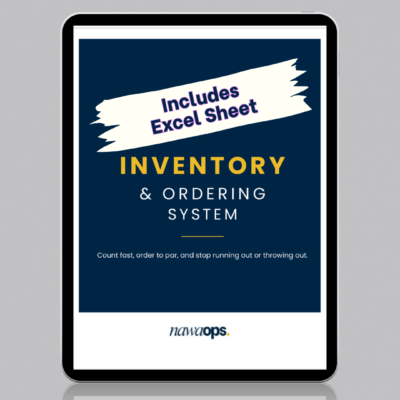
Inventory Count System Restaurant Teams Can Use

A restaurant rarely loses money in one dramatic moment. It leaks out through half-used prep containers, missing liquor pours, late invoice entries, and counts done from memory after a 12-hour shift. That is why an inventory count system restaurant operators can trust is not just an admin task. It is a control system for margin, purchasing, prep discipline, and decision-making.
The problem is not that most restaurants ignore inventory. It is that they count without a system. One manager counts chicken by case, another by pounds. The bar counts open bottles by eye. Produce is counted on delivery day one week and two days later the next. Then leadership wonders why food cost reports feel directionally useful but operationally weak.
A good system fixes that. Not by adding complexity, but by forcing consistency where restaurants usually drift.
What an inventory count system restaurant operation actually needs
Most operators buy software too early and process too late. The software matters, but only after the unit of measure, count timing, storage layout, and accountability rules are locked.
At minimum, your inventory system needs four things working together. It needs a fixed count schedule, one source of truth for item names and units, a physical storage layout that matches the count sheet, and variance reviews that lead to action. If one of those is missing, the count turns into paperwork instead of control.
That sounds basic, but this is where most failures start. If your walk-in shelves are organized by convenience while your count sheet is organized by vendor category, counting will always be slower than it should be. If one person records mozzarella in pounds and another in bags, your usage math is compromised before reporting begins.
Start with count design, not software
The strongest inventory count system restaurant teams use is usually boring on purpose. It mirrors how product moves through the building.
Begin by separating inventory into operational zones. Dry storage, walk-in, freezer, bar, and paper goods should each have a fixed sequence. Then build your count sheet to match the physical path a person walks. This is one of the simplest upgrades in restaurant operations, and it saves time every single week.
Your item list should also reflect how you buy and use product. Cases, inner packs, pounds, quarts, eaches, and bottles all need standardization. The best practice is to count in the smallest practical unit that still keeps labor reasonable. For steak, pounds may be cleaner than partial cases. For canned tomatoes, cases and individual cans may both need to exist if breakage from cases is common.
There is a trade-off here. More precision creates better variance data, but it also increases count time. A high-volume bar may need tenths of a bottle for top movers. A fast-casual concept with tight labor might accept half-bottle estimates for low-value spirits. The right answer depends on value, theft risk, and operational complexity.
The weekly count rhythm matters more than people think
Timing is not a detail. It determines whether your inventory data is useful or noisy.
A weekly count is usually the sweet spot for independent restaurants and small groups. Monthly counts are too slow to catch waste patterns. Daily full counts are unrealistic unless you are running a very high-control environment or counting only a few critical categories.
The count should happen at the same time each week, ideally when product movement is minimal. Many teams do it after close on the last day of the accounting week or before opening on the first day. What matters is consistency. If counts are done after a major truck one week and before the truck the next, your comparisons become messy fast.
For volatile items, cycle counts are a smart addition. Proteins, seafood, expensive oils, liquor, and top produce items often deserve midweek spot checks. That catches problems early without forcing a full inventory event every few days.
Build the sheet around behavior, not accounting theory
Restaurant inventory fails when it ignores how tired humans behave in a real kitchen.
Your count sheet should use plain item names, fixed units, and a sequence that follows shelf order. Related items should be grouped tightly. If diced tomatoes are on shelf two, whole peeled tomatoes should not be listed three pages later because they share a broad accounting category. The person counting should not have to think hard.
Each line should answer three questions instantly: what am I counting, where is it, and in what unit. If any of those are unclear, you get hesitation, estimation, and skipped lines.
Par levels can also live on the same sheet or inside the software view, but they should not clutter the count itself. Counting and ordering are related, not identical. During the count, speed and accuracy come first. During ordering, par logic and sales context matter.
Ownership has to be real
If everyone owns inventory, nobody owns it.
A practical inventory count system restaurant managers can sustain usually has one primary owner per area and one reviewer. The kitchen manager might own food counts, the bar manager owns beverage, and the GM or operator reviews variances and signs off. In smaller operations, one person may handle all of it, but review still matters.
That second layer is where the money is. Not because every count is dishonest, but because every count is vulnerable to blind spots. Misreads happen. Open cases get missed. Transfer items get forgotten. Review is how the system learns.
This is also where many operators stop too early. They complete the count, push the numbers into a spreadsheet or POS-linked tool, and move on. But inventory only becomes useful when variances trigger a question. Why did fryer oil usage spike? Why is tequila depletion higher than sales mix suggests? Why did chicken tender usage break pattern for two straight weeks? The count is the start of the conversation, not the end.
Software helps, but only if your data hygiene is clean
There is no shortage of restaurant inventory tools. Some are excellent. Some are glorified digital clipboards. The common mistake is assuming the app creates the discipline.
It does not.
The best software for inventory counting usually earns its keep in three areas: mobile entry, invoice integration, and reporting against theoretical usage. Mobile entry speeds counts and reduces transcription errors. Invoice integration saves administrative time and improves price tracking. Theoretical usage reporting compares what should have been used based on sales against what was actually depleted.
That said, software can amplify bad habits. If your POS buttons are messy, recipes are outdated, or invoices are coded inconsistently, your usage reports will look polished and still mislead you. Clean recipes, mapped items, and disciplined receiving are non-negotiable if you want meaningful inventory intelligence.
For smaller operators, a spreadsheet can still work well if the process is tight. For multi-unit groups, digital tools become far more attractive because standardization across sites is hard to maintain manually.
Receiving is part of inventory, whether you admit it or not
A count system breaks when receiving is sloppy.
Every delivery should be checked against the invoice, with shortages, substitutions, and damaged goods recorded before product is stocked. If invoice prices are not entered correctly, your inventory valuation drifts. If received quantities are wrong, depletion reports stop making sense. If products get placed in random locations, the next count slows down.
This is where operational leaders can be blunt. Inventory accuracy is not just a finance problem. It starts at the back door. A chef who wants cleaner food cost but waves through invoices without checking them is choosing noise.
The real payoff is better decisions, not prettier reports
A solid inventory count system restaurant leaders rely on does three things at once. It shows where margin is leaking, sharpens purchasing, and exposes process failures that sales reports alone will never catch.
It also creates better conversations. Instead of saying food cost is high, you can say produce waste is concentrated on three prep-heavy items, or draft beer variance jumped after changing shift leads, or freezer inventory is carrying two extra weeks of cash for no reason. That level of clarity changes how managers manage.
There is no perfect system. Fine-dining kitchens with dense prep trees need more precision than burger shops with short menus. Bars with deep spirit inventories need stronger controls than beer-forward concepts. A single-location neighborhood restaurant can tolerate a little manual work that a six-unit group cannot.
Still, the principle stays the same. Keep the system consistent, map it to the physical reality of the building, and review variances like they matter. Because they do.
If your counts currently feel like a weekly chore, that is the signal. Redesign the system until the numbers start answering operational questions before you even ask them.
Is Your Menu Working as Hard as Your Kitchen?
We analyze POS workflows, item engineering, and design layout to eliminate operational bottlenecks and boost profitability.